When a car accident happens, liability usually comes down to one or both drivers. Truck accidents are rarely that simple. Because commercial trucking involves a chain of companies and responsibilities beyond just the person behind the wheel, more than one party can end up legally responsible for a crash. Understanding who those parties might be helps you know what to investigate and who your claim might ultimately need to be filed against.
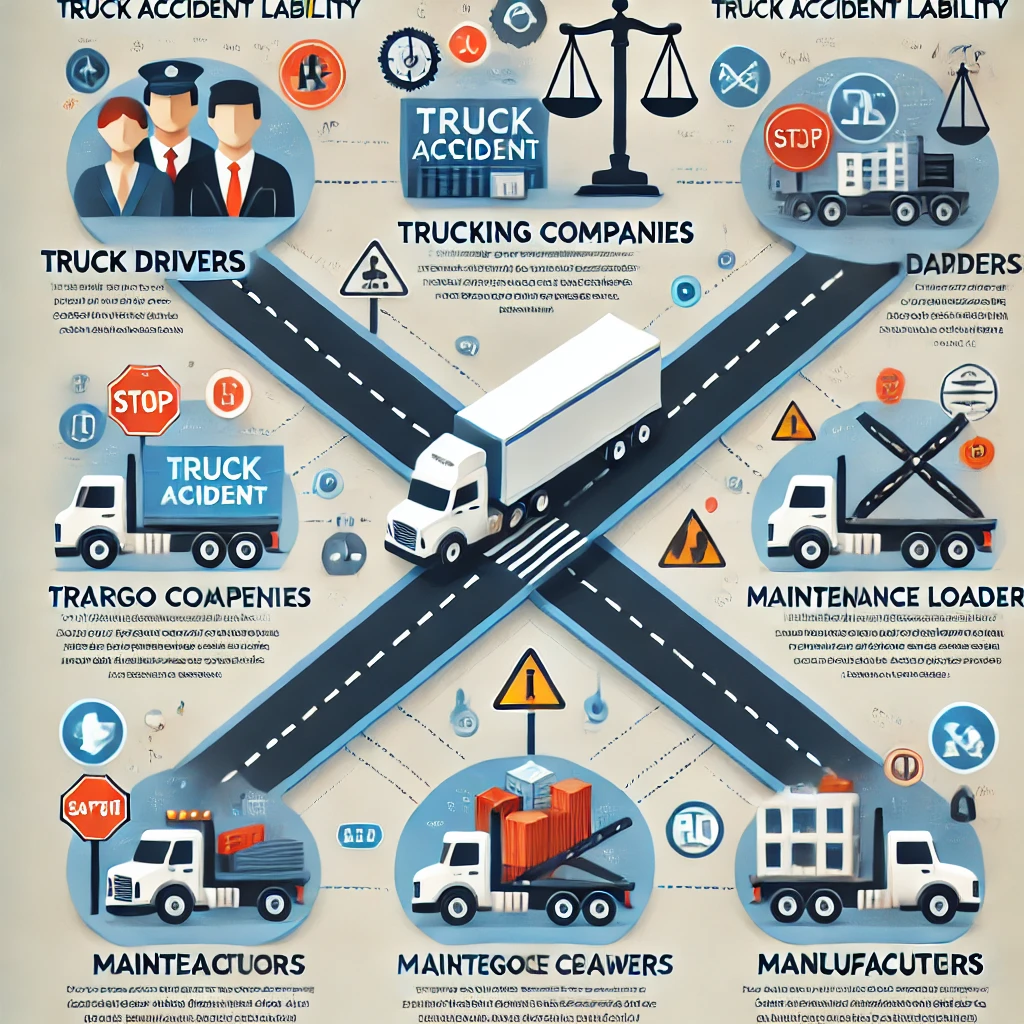
The Truck Driver
The driver is the most obvious starting point, and driver error contributes to a large share of truck accidents. Common driver related causes include:
- Fatigue, particularly from driving beyond legally permitted hours
- Distraction, including phone use or in-cab technology
- Speeding or driving too fast for road or weather conditions
- Impairment from alcohol or drugs, including some prescription medications
- Improper lane changes or following too closely
Even when the driver is clearly at fault, that does not always mean the driver personally bears full financial responsibility. Their employer is often also liable under a legal principle sometimes called vicarious liability, which holds an employer responsible for the actions of an employee performed within the scope of their job.
The Trucking Company
Trucking companies can be held liable in their own right, separate from the driver’s individual actions, in several situations:
- Negligent hiring: if the company hired a driver with a poor safety record, insufficient training, or without properly verifying qualifications
- Pressure to violate hours of service rules: if the company incentivized or pressured drivers to exceed legal drive time limits to meet delivery schedules
- Poor vehicle maintenance: if the company failed to maintain the truck according to required inspection and repair schedules
- Inadequate training: if the company did not provide sufficient training on safe operation, particularly for specialized cargo or vehicle types
Because trucking companies typically carry substantially higher insurance coverage than an individual driver would, establishing company level liability, not just driver liability, can significantly affect how much compensation is realistically available.
The Cargo Loading Company
If the truck was improperly loaded, with cargo that was unsecured, unevenly distributed, or exceeded weight limits, the company responsible for loading the cargo can share liability, particularly if the improper loading contributed to the driver losing control, a rollover, or cargo falling into the roadway.
The Truck or Parts Manufacturer
If a mechanical failure, such as brake failure, a tire blowout caused by a manufacturing defect, or a steering system malfunction, contributed to the accident, the manufacturer of the truck or the specific defective part can be held liable under product liability law. These cases typically require expert analysis to establish that a manufacturing or design defect, rather than driver error or lack of maintenance, caused the failure.
A Maintenance or Repair Contractor
When a third party company handles maintenance or repairs for the trucking company, and negligent work, such as improperly installed brakes, contributes to the accident, that maintenance provider can bear separate liability from both the driver and the trucking company.
A Government Entity
In some cases, poor road design, inadequate signage, or a failure to maintain safe road conditions contributes to a truck accident. Claims against a government entity typically involve different, often shorter, procedural deadlines and notice requirements than claims against private parties, making this one of the more time sensitive liability scenarios.
How Multiple Liable Parties Affect Your Claim
When more than one party shares responsibility, a few things typically happen:
- More potential sources of compensation: each liable party’s insurance policy may contribute to the total available compensation, which matters significantly for claims involving severe or catastrophic injuries.
- More complex investigation: establishing each party’s share of fault often requires gathering evidence such as maintenance records, hiring files, electronic logging data, and sometimes expert reconstruction of the accident.
- Potentially longer resolution time: claims involving multiple defendants and insurers generally take longer to resolve than a straightforward single vehicle claim.
- Comparative fault calculations: depending on your jurisdiction, if the injured party shares any fault, compensation may be reduced proportionally, adding another layer to the calculation when multiple parties are already involved.
Evidence Used to Establish Liability
- The police accident report and any citations issued
- The truck’s electronic logging device data, showing speed, braking, and hours driven
- The driver’s employment and training records
- Vehicle maintenance and inspection records
- Cargo loading manifests and weight documentation
- Witness statements and, where available, dashcam or nearby surveillance footage
- Expert accident reconstruction analysis for disputed or complex cases
How This Varies by Country
In the United States, commercial trucking is regulated at the federal level through hours of service rules, driver qualification standards, and vehicle maintenance requirements, all of which can become relevant evidence. The United Kingdom, Canada, and Australia each maintain their own regulatory frameworks for commercial vehicle operation, with different enforcing bodies and specific requirements, though the general categories of potentially liable parties, driver, company, manufacturer, and maintenance provider, remain broadly similar across these jurisdictions.
Frequently Asked Questions
Can I sue both the driver and the trucking company?
In many cases, yes. Both can be named in the same claim if evidence supports that each contributed to the accident, whether through the driver’s direct actions or the company’s hiring, training, or maintenance practices.
What if the trucking company blames the driver entirely?
This is a common defense strategy, and it is one reason a thorough investigation into hiring records, training, and company policies matters. A driver’s individual mistake does not automatically absolve the company if company practices contributed to the conditions that led to it.
How long does it take to identify all liable parties in a truck accident?
This can take time, particularly for complex cases involving equipment defects or maintenance disputes, which is one reason prompt evidence preservation requests are important before records or data are lost.
Does it matter if the truck driver was an independent contractor?
It can. Whether a trucking company is liable for an independent contractor driver’s actions often depends on how much control the company exercised over the driver’s work, which is a fact specific legal question.
The Bottom Line
Liability in a commercial truck accident frequently extends beyond the driver to include the trucking company, cargo loaders, manufacturers, or maintenance providers, depending on what actually caused the crash. Identifying every potentially responsible party matters both for fairness and because it directly affects how much compensation may realistically be available to cover serious injuries.
Disclaimer: This article is for general informational purposes only and does not constitute legal advice. Liability rules for commercial vehicles vary by jurisdiction. Consult a licensed attorney for guidance specific to your situation.
Last updated: September 2026. Sources and methodology: general guidance based on publicly available trucking safety regulations and legal industry resources. Verify specific rules and requirements for your state or country.