
Last reviewed: October 2026 · How we research: How We Research
Falling in a store, an apartment building or a parking lot doesn’t automatically mean someone else is responsible. Property owners aren’t required to guarantee that nobody ever slips. They are required to act reasonably: to inspect their property, fix dangerous conditions and warn visitors about hazards they can’t fix right away. A slip and fall claim succeeds when you can show the owner fell short of that duty and that this caused your injury. This area of law is called premises liability, and its rules are different enough from car accident claims that many valid cases are lost through misunderstanding them.
Falls are a serious public health problem. According to the CDC, about one in four adults aged 65 and older reports falling each year, and falls are the leading cause of injury death in that age group. Not every fall involves negligence, but many are caused by hazards that should have been found and fixed.
What you need to prove
In most states, a slip and fall plaintiff must show four things:
- A dangerous condition existed on the property: a spill, broken step, loose mat, uneven pavement, poor lighting, missing handrail or ice.
- The owner knew or should have known about it (called “notice”), or created it themselves.
- The owner failed to act reasonably: they didn’t fix the hazard, block it off or warn you in time.
- The condition caused your fall and your injuries.
The two issues that decide most cases are your status as a visitor, which sets how much care the owner owed you, and notice, which is about whether the owner had a fair chance to fix the problem.
Why you were there matters
Traditionally, the law divides visitors into three categories, each owed a different level of care:
Invitees
Customers, clients, business visitors
Highest duty. The owner must regularly inspect for hazards, fix them within a reasonable time and warn of those not yet fixed.
Licensees
Social guests, friends, people with permission
Middle duty. The owner must generally warn about dangers they know of that a guest wouldn’t notice, but needn’t inspect for unknown ones.
Trespassers
No permission to be there
Lowest duty, mainly not to harm them deliberately. There are exceptions for children drawn by hazards such as pools (“attractive nuisance”).
Not every state uses these categories. California abolished them in 1968 (Rowland v. Christian), and a number of other states have since replaced or merged them, applying a general standard of reasonable care to all lawful visitors. In those states the question is simply whether the owner acted reasonably in the circumstances.
Notice: did the owner know, or should they have?
Unless the owner or its employees created the hazard, you usually must prove one of two kinds of notice:
- Actual notice: the owner or staff knew about it. Examples are a customer who reported the spill, an employee who walked past it, or earlier complaints about a broken step.
- Constructive notice: the hazard existed long enough that a reasonable inspection would have discovered it. Evidence includes footprints or cart tracks through a spill, dried edges, dirt in the liquid, or video showing how long it was there.
This is why slip and fall cases are often won or lost on timing. A grape dropped seconds before your fall is hard to blame on the store. A puddle from a leaking freezer that staff walked past for an hour is a different story. Some states also apply a “mode of operation” approach to self-service businesses, such as salad bars or bulk produce, where spills are a foreseeable part of how the business operates. That can reduce the need to prove how long a specific hazard was there.
Check your situation
Answer five questions to see which issues will matter most in your claim.
Slip and fall claim checker
A general guide to the issues, not legal advice. Premises liability rules vary considerably by state.
Common hazards behind slip, trip and fall claims
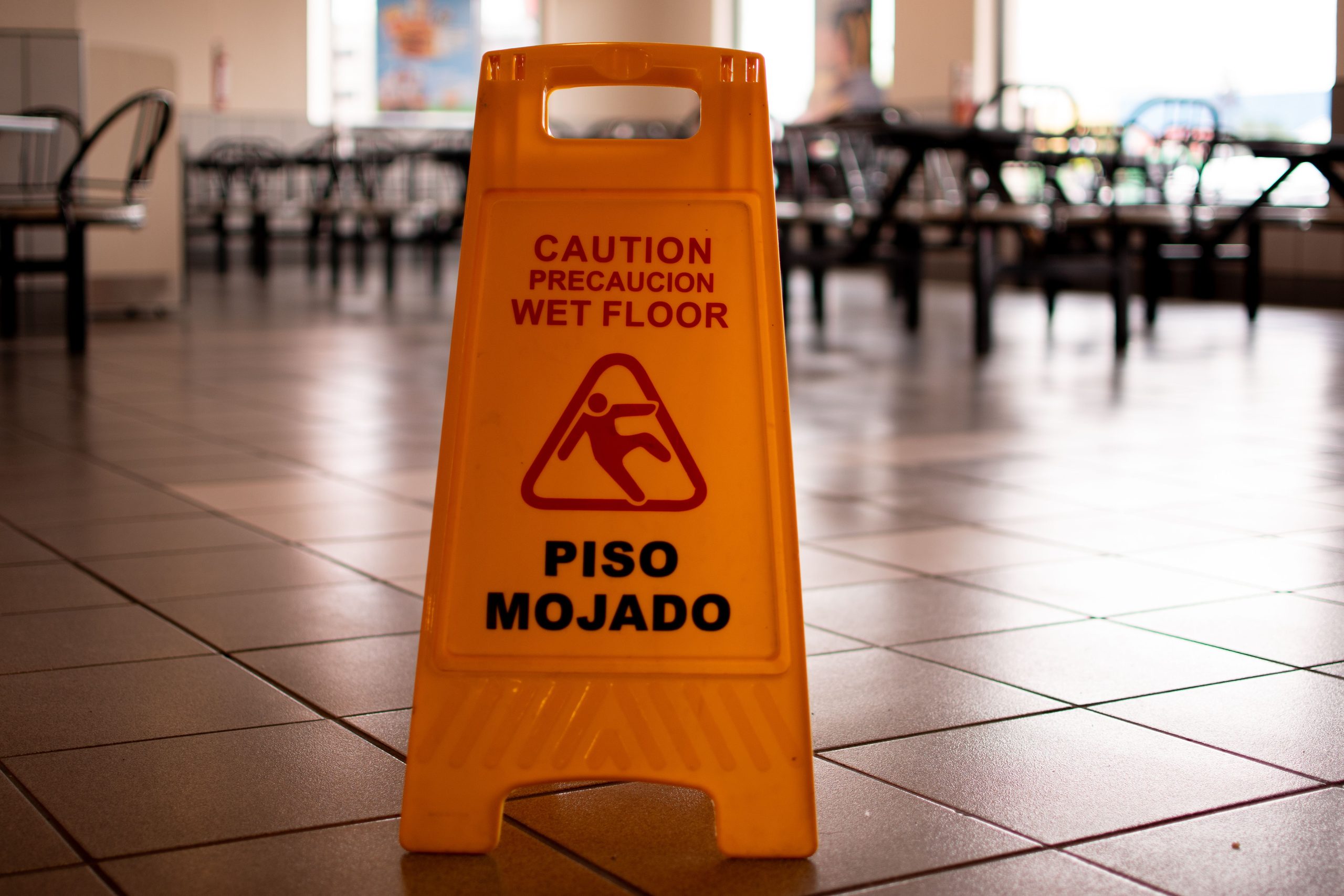
- Wet or slippery floors: spills, mopped floors without warning signs, tracked-in rain, leaking coolers.
- Stairs: broken or uneven steps, missing or loose handrails, worn treads, poor lighting.
- Walkways and parking lots: potholes, cracked pavement, raised sidewalk slabs, curbs without markings.
- Ice and snow: rules vary a lot by state. Some give owners a reasonable time after a storm ends to clear it.
- Clutter and obstacles: boxes in store aisles, cords across walkways, curled rugs and mats.
- Building code violations, such as stair dimensions or handrail heights, which in some states can be evidence of negligence.
Evidence disappears fast
Unlike a car crash, a slip and fall scene changes within minutes: the spill is mopped, the mat straightened, the ice salted. Many businesses record over surveillance video automatically after a short period. If you can, and only once your health allows:
- Photograph the hazard before it’s cleaned up, from several angles, including anything that shows how long it was there, and the lack of warning signs.
- Report the fall to the manager or owner and ask for a copy of the incident report, or at least the name of the person who took it.
- Get names and phone numbers of witnesses, including employees who saw the hazard or your fall.
- Keep your shoes and clothing as they were.
- Send a preservation letter quickly, or have a lawyer send one, asking the owner to keep video footage, inspection logs and cleaning records.
- See a doctor the same day or as soon as possible, and describe exactly how you fell.
Be careful what you say at the scene. A reflexive “I’m fine” or “I wasn’t looking” can be written into the incident report and used later. Stick to the facts.
How owners and insurers defend these claims
- “Open and obvious.” The hazard was so visible that you should have avoided it. In some states this can bar a claim; in many it’s treated as part of comparative fault. It is weaker when something reasonably drew your attention away, such as product displays or carrying items.
- No notice. The hazard appeared moments before, so there was no reasonable chance to fix it.
- Your own fault. You were looking at your phone, wearing unsuitable shoes, running, or had been drinking. In most states this reduces your recovery by your percentage of fault; in the few contributory negligence states (Alabama, Maryland, North Carolina, Virginia and D.C.) it can bar recovery entirely.
- Your injuries weren’t caused by the fall, or were pre-existing.
Special situations
Falls on public property. Claims against a city, county, state or public agency usually require a formal written notice of claim within a short time: 90 days in New York, six months in California and Texas, for example. Some governments are also immune from certain claims. Act quickly. Our statute of limitations guide lists general deadlines by state.
Falls at work. If you fall at your own workplace, workers’ compensation usually covers your medical bills and part of your wages, regardless of fault, but you generally can’t sue your employer. You may still have a separate claim against another company, such as the building owner or a contractor. See workers’ comp vs. a lawsuit.
Rental properties. Landlords are generally responsible for common areas such as stairways, hallways and parking lots, and for repairs they knew about or were required to make. Inside a tenant’s unit, responsibility often depends on the lease and on whether the landlord was told about the problem.
Falls at someone’s home. These are usually paid by the homeowner’s or renter’s insurance, not by your friend or relative personally. Many people hesitate to claim against someone they know, but the policy exists for exactly this situation.
Frequently asked questions
Can I sue a store if I slipped and wasn’t seriously hurt?
You can make a claim, but compensation depends on your injuries and losses. If you had minor bruising and no treatment, there may be little to recover. Get checked by a doctor anyway; some injuries, such as concussions or back injuries, show symptoms later.
The store says there was a warning sign. Does that end my claim?
Not necessarily. The question is whether the warning was adequate: visible, placed where you would see it before reaching the hazard, and appropriate to the danger. A small sign several aisles away may not be enough.
Do I need a lawyer for a slip and fall?
Premises cases are harder to win than many car accident claims, because proving notice often requires prompt investigation and access to the owner’s records and video. For anything beyond minor injuries, a consultation is worthwhile; most lawyers offer one free and work on contingency. See how lawyer fees work.
Sources
- Centers for Disease Control and Prevention: Older adult falls data
- Cornell Law School, Legal Information Institute: Negligence
- Rowland v. Christian, 69 Cal. 2d 108 (1968)
This guide is general information, not legal advice. Premises liability law differs significantly from state to state; consult a personal injury lawyer licensed in your state about your fall.